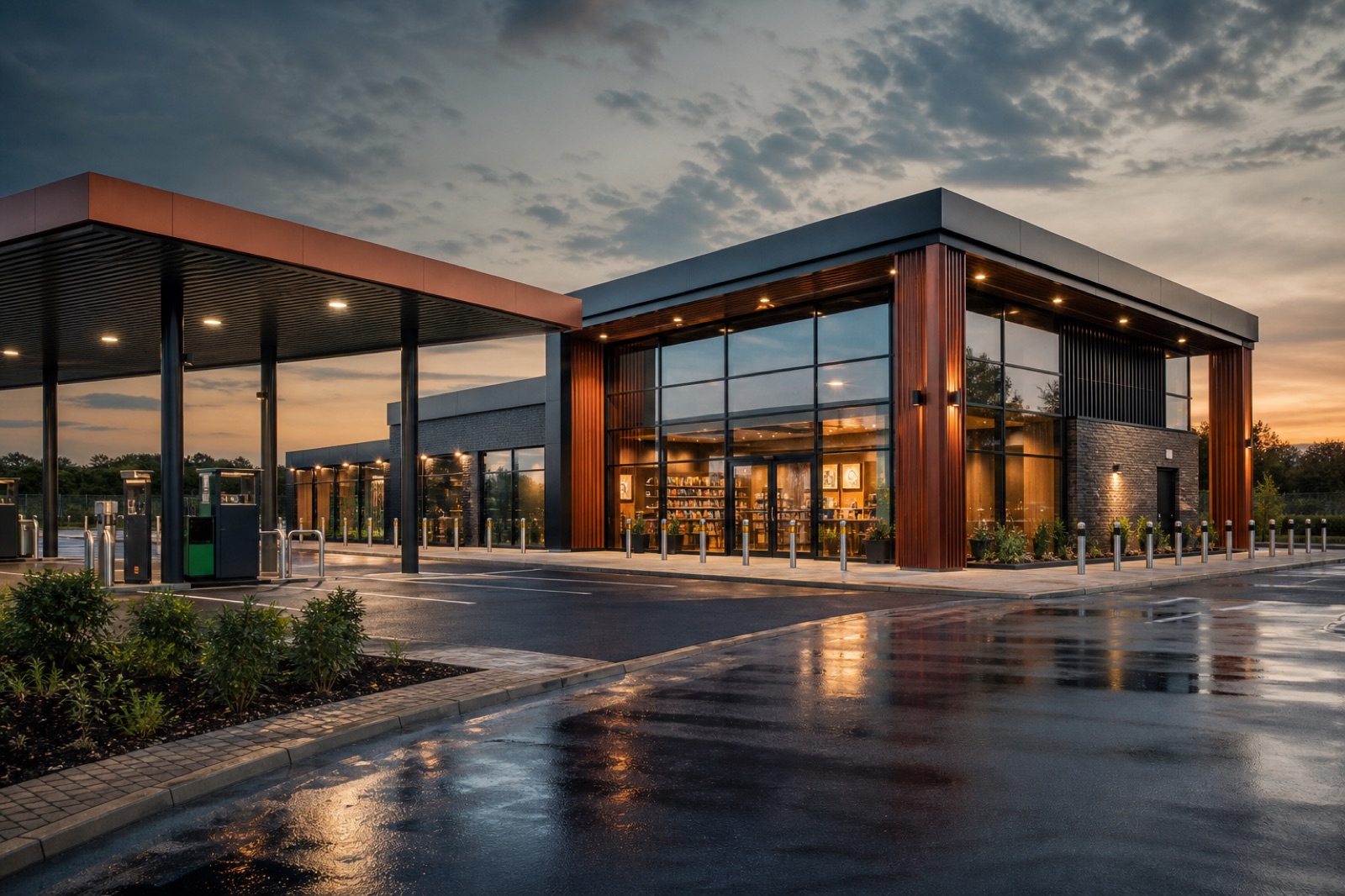
Roadside and leisure stabilisation finance
We arrange stabilisation finance for developers and operators carrying new roadside and leisure schemes from completion or opening through the early trading ramp to a stabilised operating income. These schemes generate little income during fit-out and the first trading months, so this is the short-dated bridge across that gap, not a regulated home loan or a personal loan.

Stabilising roadside & leisure
Roadside and leisure spans forecourts with drive-thru and convenience, leisure and trade parks, pubs and visitor attractions. Roadside in particular is moving from niche to institutional: first-half 2025 transactions topped full-year 2024, and pubs and leisure show strong buyer demand, with Christie & Co reporting a 4.2% rise in its leisure price index. Long-lease indexed roadside assets trade keenly, with one forecourt and services transaction evidencing a net initial yield near 4.79% (Savills, 2025), a transaction example rather than a published market-wide prime yield.
Roadside and leisure stabilisation finance is the short-dated bridge that carries a new or repositioned scheme from completion or opening through the early trading ramp to a stabilised operating income. These schemes generate little income during fit-out and the first trading months, and a lender on long-term investment debt wants to see a trade build-up and lease evidence before it prices the asset, so stabilisation finance funds the gap in between.
The credit case turns on the trading ramp and the income it builds, not on any one borrower's personal income. Lenders read the operator or tenant covenant, the lease structure on a let scheme, the catchment and traffic, and the gap between the day-one value and the stabilised value the proven trading income will support. They size against loan to value during the ramp, the debt yield the building income produces, and interest cover, with a clear exit onto investment debt or a sale once the scheme trades to plan.
We package the scheme, the operator or tenant, and the trading assumptions so lenders comfortable with operational and roadside risk can price the ramp quickly, and we run the market across stabilisation, development exit and term lenders rather than approaching a single bank.
What we fund
- Forecourts with drive-thru and convenience opening to trade
- Drive-thru and roadside food and beverage units
- Leisure and trade parks letting up and building footfall
- Pubs and visitor attractions ramping income after works
- Repositioned roadside schemes proving a new trading income
- Let roadside assets stabilising ahead of a long-income refinance
Indicative terms
- Loan to value during the rampCommonly around 65 to 75% of value
- TermShort-dated, typically 12 to 36 months through the trade ramp
- Income basisOperating income building, or contracted lease income
- Trading testLenders weigh trading and EBITDA on operated assets
- Interest coverTested against building income; often part-serviced
- Key testsOperator or tenant covenant, lease, catchment, trade ramp
- ExitInvestment or long-income refinance, or sale, once stabilised
Indicative only. Terms vary by lender, asset and scheme and are not an offer of finance.
How we arrange roadside and leisure finance through the ramp
We arrange roadside and leisure finance around the trading ramp and pre-agree the exit. For a scheme opening or recently opened, we place stabilisation finance commonly to around 65 to 75% of value, short-dated across the ramp, sized on the income the scheme generates today and its trajectory to a stabilised operating income. Where the scheme was just built, development exit finance repays the development facility and gives the asset room to trade without a construction loan running on. On operated assets, lenders weigh trading performance and EBITDA, so interest is often part-serviced while income builds. On a let scheme, the lease and the tenant covenant lead the underwriting. We pre-agree the route onto an investment or long-income term loan, or a sale, once the scheme trades to plan. We frame every figure as indicative and never as an offer; the terms depend on the scheme, the operator or tenant, and the pace of the trade build-up.
What lenders assess on a ramping scheme
Lenders underwrite roadside and leisure on the operator or tenant covenant, the lease where the scheme is let, the catchment and traffic, and the trade ramp, then size against loan to value, debt yield and interest cover. On operated assets they weigh trading and EBITDA closely, because the building income underwrites the loan and the exit; on let assets the lease length and covenant lead. Roadside is institutionalising fast, which deepens the pool of lenders and buyers comfortable with these schemes, but a hotel, care home or office lender prices operational ramp risk very differently, so the fit matters. As a broker with no exclusive tie, we present the operator and the trading evidence honestly and place the case with the lender most comfortable with roadside and leisure risk. We arrange the finance; we do not lend, and we are not FCA-authorised because this is unregulated commercial lending.
From trade ramp to a stabilised income
A roadside or leisure scheme's exit rests on proving a stabilised operating income, after which it refinances onto investment or long-income debt or sells. The destination is supported by a market moving from niche to institutional: roadside first-half 2025 transactions topped full-year 2024, a 4.2% rise in the Christie & Co leisure price index, and long-lease indexed roadside trades near a 4.79% net initial yield on a 2025 transaction example (Savills). On a let scheme, a long indexed lease to a strong covenant prices close to long-income property; on an operated scheme, the exit rests on demonstrable trading. Once the scheme stabilises, we term out the bridge onto a senior investment or long-income loan, or arrange a cash-out refinance to release equity. For a stabilisation lender, that clear route from a building trade to a refinanceable income is what supports the loan on day one.
Finance that suits this asset class
- Stabilisation bridge financeCarries the scheme from opening through the trade ramp to a stabilised income.
- Development exit financeRepays the construction loan and gives the asset room to trade.
- Bridge-to-term financeStructures the move from the stabilisation bridge onto long-term debt.
- Senior investment term loansLong-term or long-income debt once trading stabilises.
- Cash-out refinanceReleases equity from a stabilised scheme into the next project.
Stabilising roadside & leisure?
A view on fundability within one working day.
Frequently asked questions
What is leisure finance?
Leisure finance, as we use it, is finance arranged against a leisure or roadside property and its operating income: forecourts, drive-thrus, leisure parks, pubs and attractions. Stabilisation finance is the short-dated bridge that carries a new or repositioned scheme from opening through the early trade ramp to a stabilised operating income, ahead of a refinance onto long-term investment or long-income debt. It is commercial finance against the asset, not a consumer loan.
Is this a bridging loan?
Yes, in substance. Roadside and leisure stabilisation finance is a specialist commercial bridging loan: it is short-dated, secured on the asset, and structured to be repaid by a refinance or sale rather than out of personal income. The difference from a generic bridge is that it is built around the trade ramp, with the term, the part-serviced interest and the exit all set to the pace at which the scheme reaches a stabilised operating income. We arrange that bridging loan and the term debt that follows; we do not lend, and this is unregulated commercial finance.
Is it hard to get a mortgage on a commercial property?
It is harder than a residential mortgage and underwritten differently: a commercial lender prices the asset, its income and, on a trading property, its EBITDA, rather than a personal salary. On a roadside or leisure scheme still ramping income, mainstream term lenders often wait for stabilised trading, which is exactly the gap stabilisation finance fills before a term refinance. As a broker we place the case with the lender whose appetite matches the asset and its trading stage.
Who do DFS use for finance?
DFS, the furniture retailer, arranges its own customer point-of-sale credit through finance providers, which is a consumer-retail arrangement and unrelated to what we do. We arrange commercial property finance for the developers and operators behind roadside, retail-warehouse and leisure schemes: the stabilisation bridge across a trade ramp and the investment debt that follows, against the asset and its income.
Can you get a mortgage to buy an Airbnb?
Short-let and serviced-accommodation assets are financed as operating property, not on a standard residential mortgage, because income depends on occupancy and trading. For a scheme still building its trade, stabilisation finance bridges the ramp from opening to a demonstrable stabilised income, after which a term lender can refinance. We arrange that commercial finance against the asset and its income, and do not arrange regulated home loans.
What is the meaning of leisure property?
Leisure property is commercial real estate occupied by businesses people visit for recreation and everyday services: gyms, restaurants, drive-throughs, cinemas, family entertainment, trampoline and padel centres, and the roadside retail that sits alongside them. It is valued on the strength of the operator's trade and lease rather than on a simple rack rent, which is why lenders test the covenant and trading history closely and why arranging the right lender for the sub-sector matters.
Stabilising roadside & leisure?
Tell us about the asset and the income plan and we will come back with a view on fundability and likely terms.